
You've decided to spend less this month, and in your head every single fun thing in your life has already been crossed off. By day three you feel the pressure like it's an exam you haven't studied for. Then it's midweek, you order takeout on the back end of a massive day, and suddenly you're thinking, crap, I've blown it.
Real life doesn't stop just because you've planned a no-spend month. There'll be a birthday, a car that won't start, a week where nobody can face the kitchen.
So let's plan a values-based no-spend month instead, where you keep the things you love and still leave room for real life. Grab a pen and some paper, or open your notes app, and let's do it together.
Start your no-spend month with a keep list
Grab a piece of paper or open your notes app and write "Keep" at the top. Underneath go the things that carry on no matter what:
- Rent and the bills
- Groceries and medicine
- Getting to work
Now add one or two things you'd really miss. Picture the month without them and notice which one makes you go, oh no, not that. Maybe it's your monthly coffee with a friend, the dog's treats, or the swimming lessons someone you love lights up about.
Pick yours and write them down. Just one or two, though, or it's really just last month on repeat!
For example, say you put $40 on your list for that coffee with your friend. Spending that $40 doesn't count as a wobble, because protecting things like that coffee is what this month is for.
Keep
Rent and bills
Groceries and medicine
Getting to work
Coffee with a friend, $40
Pause
Takeout, $120
Online orders, $80
Pick what to pause during your no-spend month
Next to "Keep", write "Pause". Keep this list short, two or three things at most.
Open your banking app and scroll back through last month. You're looking for money that went out without much joy attached. Maybe it's the takeout you ordered because nobody could face the kitchen, or the parcels you'd half forgotten by the time they turned up. Pick the two you'd miss least.
Say last month's takeout came to $120 and the online orders came to $80. Pause both, and that's $200 you don't spend this month. And it's only a pause. You know exactly when it ends, which makes it so much easier to start.
Everything that isn't on either list carries on as normal, so you're only keeping an eye on your pause list. That's small enough to hold in your head on a busy Wednesday, when dinner still needs making and you're running on empty.
Write your bounce-back note before you need it
A wobble is when something from your pause list ends up in your cart anyway. It'll probably happen once or twice (you're human!), so decide what you'll do about it now, while you're calm and nothing's gone wrong.
Write a short note at the bottom of the page, something like: "I bought takeout on Tuesday, so I'm back to pausing from tomorrow." Change the words until they sound like you.
Then stick the page somewhere you'll see it: the fridge, the inside of a cupboard door, or the first note in your phone. You'll want to find it fast on the day you wobble.
When it happens, jot the date and the amount in your notes app and leave it there. If it was a $25 takeout on day nine, you've still had eight days of sticking to your plan. Read your note, and carry on tomorrow.
If your wobbles tend to be spur-of-the-moment buys, my post on curbing impulse spending without feeling deprived has some ideas.
What to do with the money you didn't spend
Leave a space at the bottom of your page for the last day of the month. That's the fun bit: you open your banking app and see what stayed put.
In our example, that's the $200 you didn't spend, and you get to decide where it goes. Maybe $100 goes to savings and $100 goes on something you'll really enjoy, like that skincare you've been eyeing, no apology needed. Write your choice down on the last day, so it's sorted before the new month starts.
If you're building savings from nothing, my post on emergency funds made simple shows where that first $100 can go.
Your keep list
I'm curious what made it onto yours. Pop the one thing you're protecting this month in the comments.
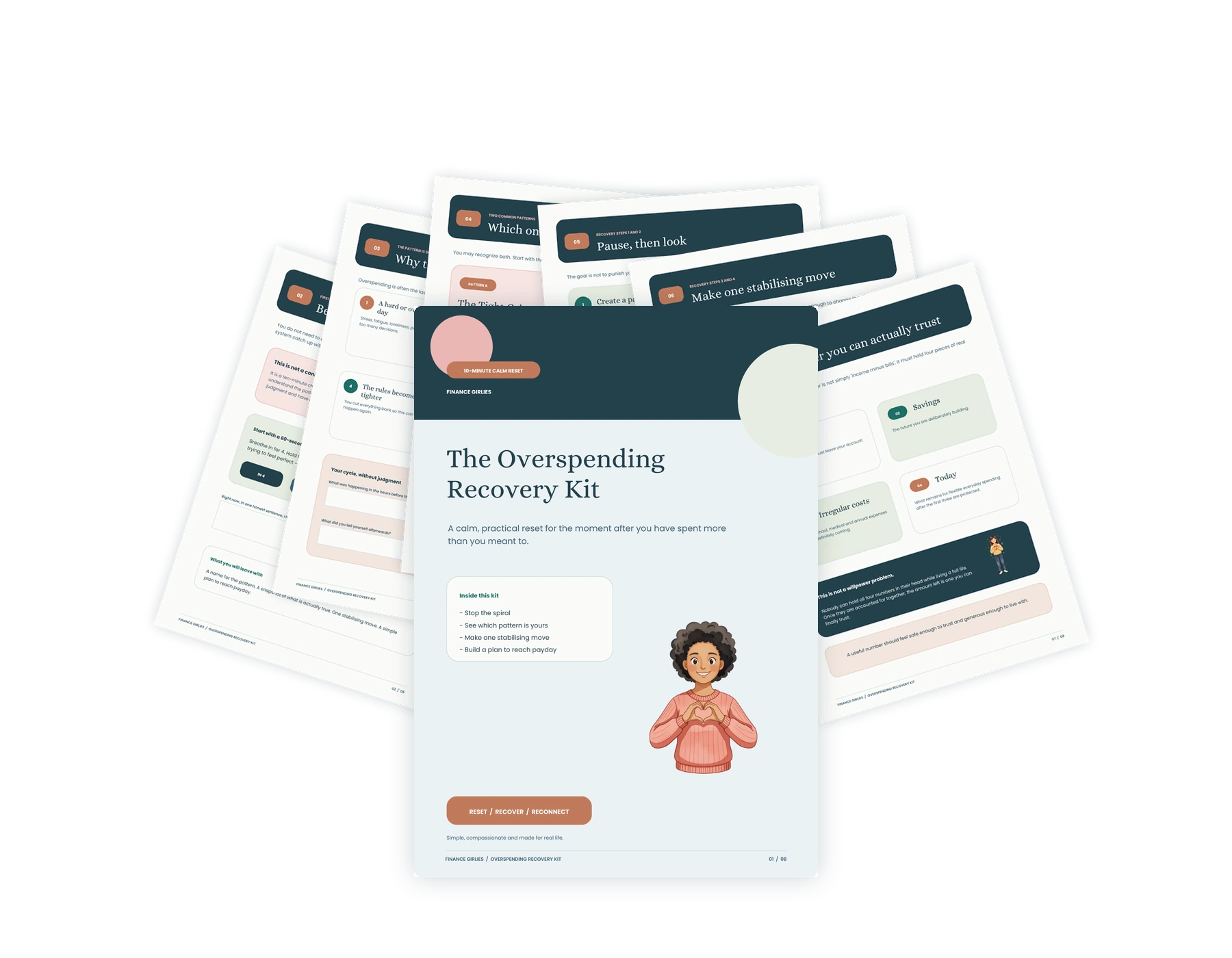
Coming off a heavy spending month?
Before the keep list, it helps to see where things stand. The free Overspending Recovery Kit starts with one page for your balance, the bills due before your next payday and one thing to do about it. It takes about ten minutes.
Get the free Overspending Recovery KitFree. Eight pages, on screen or printed.Now picture day 30. You've had your coffees with your friend, a takeout or two along the way, and there's an extra $200 sitting in your account, saved from things you'd have forgotten by Friday. Now that's a no-spend month you'll want to do again!
This is general education, not legal, tax or financial advice.
One Comment
Comments are closed.