
You're scrolling your inbox in early November and there it is, the first holiday sale email. Wait, the holidays are only six weeks away?! Suddenly you're doing sums in your head: the presents, the food, the cards, the fuel for the drive. And somehow it all seems to land on the same pay.
On its own, each of those costs is pretty small. They feel huge because they all turn up in the same few weeks, and nobody added them up ahead of time.
So let's do the adding now. This November money reset takes five small moves across the month, and spreads your holiday spending over the paydays you've still got.
Starting partway through November?
If it's early November: the names, the numbers beside them, and the other costs.
If it's mid November: add the cushion and divide by your paydays.
If the sale emails have started: write the list tonight, with a top price for each thing.
Week one: your holiday gift list and the costs around it
Move 1. Some evening this week, write down everyone you'd like to give something to, with a number beside each name. Just the number for now. The actual gift can wait. For example, say it's six people at $25 each. That's $150.
If a number looks too high once it's on paper, lower it, or swap that gift for a handwritten note. It's so much easier to change a number now than to put back a gift you're already holding in mid December.
Move 2. On the same page, add what the holidays cost apart from the presents:
- Food for a get-together
- Fuel for a trip
- Postage for the cards
- A roll or two of wrapping paper
Say food is $60, and postage and wrapping come to $30. That's $90.
Add that to the gifts and you're at $240. Whatever that number makes you feel, it's so much better to see it now than at the checkout in December.
Week two: split your holiday budget across your paydays
Move 3. There's nearly always one thing nobody planned for, like the teacher gift you forgot or the dish you're asked to bring the Thursday before. So add a $30 cushion for it.
Now your holiday total is $270: $240 plus $30. If the $30 doesn't get used, it stays in your account for the new year. Bonus!
Move 4. Count your paydays between now and the holidays. Say you're paid every two weeks and the holidays are six weeks away. That's three paydays, and $270 divided by three is $90 from each pay.
On each of those paydays, move the $90 into its own spot as soon as your pay lands in your account, before you've had a chance to spend it. Paid weekly or monthly? Count your own paydays and divide the total by that number instead.
Ninety dollars a pay feels so much lighter than $270 all at once in mid December, doesn't it?
Week three: write your sale list before the big sales
Move 5. The big sale weekend usually lands near the end of November, and the emails start well before it. Everything in them looks like a bargain, especially anything with free shipping.
You know how it goes. It's 11pm, you're on the couch, and an email says 40% off plus free shipping. Your thumb's already halfway to the button.
So this week, before the emails really get going, write a short sale list: the gifts you've already chosen, and the most you'd pay for each one. That's the list you shop from. Everything else in your inbox can float on by.
If the late-night cart is the bit you dread, my post on curbing impulse spending without feeling deprived walks you through it.
Week four: check in on your holiday spending
By the last week of November you'll have had at least one payday with $90 moved across, a total on paper and a list for the sales. Grab your list and your banking app for five minutes, and ask yourself:
- Did the $90 move?
- Did you buy anything that wasn't on the list?
If the $90 didn't move, or you picked up something that wasn't on the list, write down what happened and how much. Then look at the paydays you've got left. Maybe the next one needs to be a bit bigger, or a gift needs a smaller number beside it. It's still November, so there's plenty of time to adjust.
If you'd like a ten-minute way to do that look back, my post on how to review your finances at the end of each month walks through it.
The one that gets forgotten
Everyone has a holiday cost that never makes the list. Leave yours in the comments so the rest of us can add it to ours.
When the holiday total looks tight
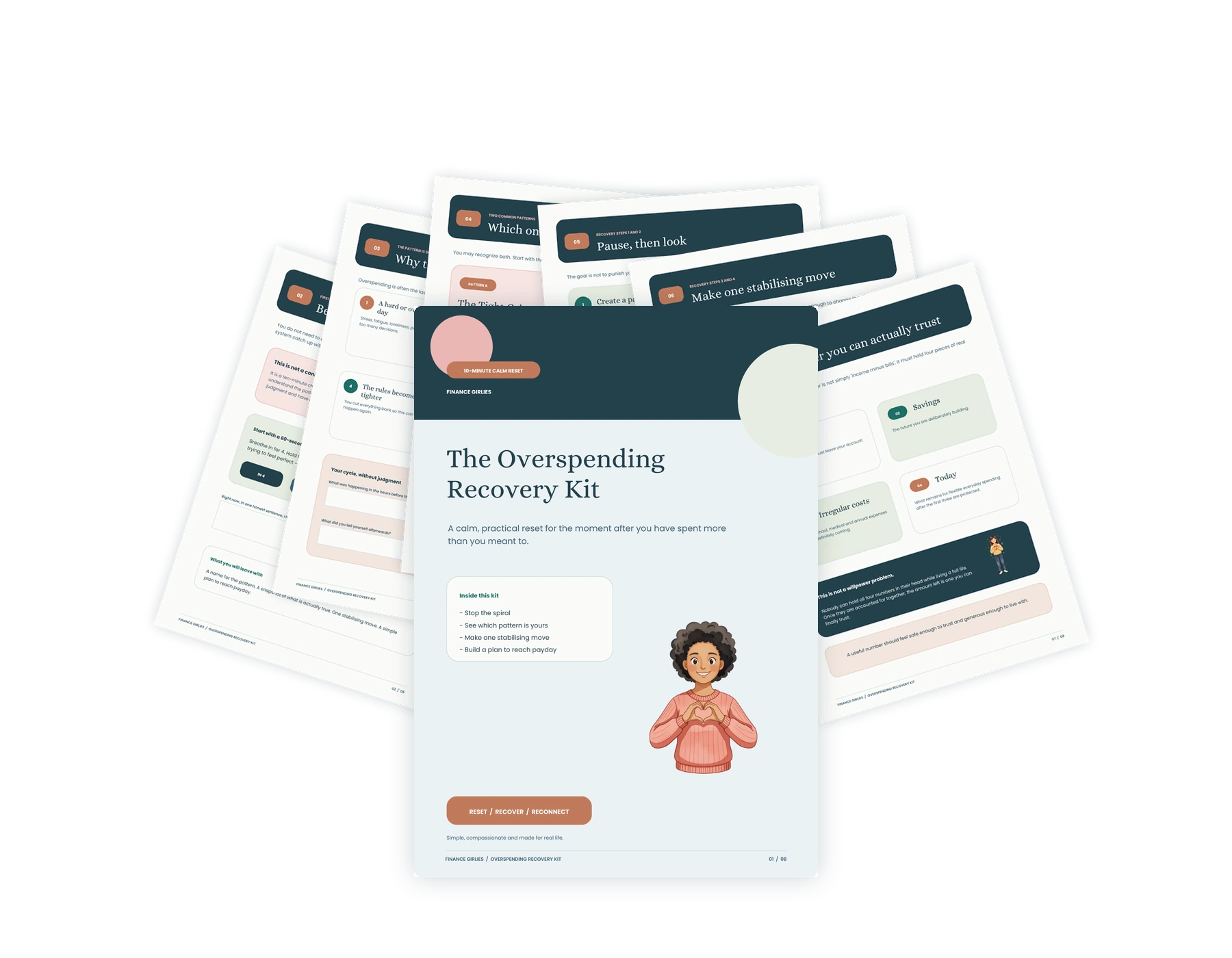
If your list shows more than you have room for this month, start with where things stand today. The free Overspending Recovery Kit starts with one page for your balance, the bills due before your next payday and one thing to do about it. It takes about ten minutes.
Get the free Overspending Recovery KitFree. Eight pages, on screen or printed.Then picture mid-December. The presents are wrapped, the food's sorted, and when you pay for the last gift, the money for it is already sitting there, waiting. That's the December you're setting up right now.

This is general education, not legal, tax or financial advice.