
How to Streamline Your Financial Life: Leveraging Multiple Bank Accounts to Organise Finances
Your income hits your account, bills come out, you tap your card on autopilot—and suddenly it’s the end of the month and your savings haven’t budged. Sound familiar?
When everything funnels through one account, it’s easy to lose track of what’s meant for rent, what’s for brunch, and what should be going towards that Bali trip or your emergency stash. Without a system, money becomes a blur—and with that blur comes stress, guilt, and missed goals.
Here’s the truth: You don’t need to earn more to feel financially confident—you need structure. By using multiple bank accounts to organise finances, you create clarity, reduce decision fatigue, and finally feel in control.
This isn’t about complicating things—it’s about making your everyday money life simpler. With the right setup, your accounts can do the heavy lifting for you.
🎯 Action Step: Take 10 minutes today to write down all your current accounts. What are they used for? Are they working hard for you—or just sitting there?
🧠 Understanding the Psychology Behind Financial Organisation
😵 Why We Struggle with Financial Organisation
Money avoidance is real—and it’s more common than you think. When our finances feel disorganised or overwhelming, many of us respond by tuning out instead of tackling the issue head-on.
This isn’t about laziness—it’s psychological self-protection. Your brain sees financial chaos as a threat, so it tells you to procrastinate. But that only makes things worse over time.
A 2025 NAB Australian Wellbeing Survey found that over 1 in 3 of us view money as a very significant source of stress in our lives. So that tension can erode not just your financial progress, but also your mental health and confidence.
🧠 The Benefits of Mental Accounting
Mental accounting is a behavioural finance concept where people treat money differently based on its purpose. Think of it like giving each dollar a job—rent, fun, groceries, future-you savings.
The problem? If all your money sits in one pot, those mental categories get fuzzy fast. That’s where separate accounts come in. They turn mental accounting into actual structure—making it easier to stick to goals without constant willpower.
- A ‘Bills’ account: Covers fixed expenses like rent and utilities.
- A ‘Fun’ account: Guilt-free spending on whatever brings you joy.
- A ‘Goals’ account: For savings like holidays or house deposits.
- An ‘Emergency’ account: For unexpected life curveballs.
🎯 Action Step: Grab a notebook or Notes app and jot down how you’d categorise your income into 3–5 buckets. What do you wish you had more control over?
🏗️ Setting the Foundation: The Essentials of Multiple Bank Accounts
🏦 Types of Accounts for Different Financial Goals
You don’t need ten accounts—but having a few purpose-built ones can make all the difference. Here’s a simple breakdown:
- Everyday Transaction Account: Use this as your income hub where pay hits and outgoing transfers begin.
- Bills Account: Automatically set up direct debits here for rent/mortgage, subscriptions, insurance—anything that recurs monthly or quarterly.
- Savings Account: This is for short-to-mid-term goals like a car upgrade or travel fund. Look for high-interest options with no fees (think ING Savings Maximiser or Macquarie Bank).
- Emergency Fund Account: Keep this separate from other savings—ideally with limited card access so you’re not tempted to dip in unnecessarily.
- Investment Holding Account: If you’re investing through platforms like Pearler or Spaceship, having an account that feeds into them can help automate wealth-building.
🇦🇺 The Australian Banking Landscape: Choosing the Right Institutions
The good news? Australia has plenty of banks offering fee-free accounts with digital tools that make money organisation easier than ever. But not all banks are created equal.
- User-friendly interfaces: Banks like Up make setting up sub-accounts (called “Savers” or “Buckets”) seamless via app.
- No monthly fees: Avoid paying just to have an account—providers like Macquarie and ING offer zero-fee options.
- Savings incentives: Some banks offer bonus interest if you meet simple conditions (like depositing $1k/month).
- Sustainability & ethics: Platforms like Bank Australia align with values-driven banking if that matters to you.
🎯 Action Step: Audit your current bank accounts today. Are they helping—or hindering—your financial goals? Check interest rates, monthly fees, and user experience. Consider switching if needed!
⚙️ Implementing Your Organised System
📂 Steps to Segregate Your Finances
You’ve mapped out your categories—now let’s bring them to life with actual bank accounts. Here’s how to set it up step-by-step:
- Create separate accounts: Start with 3–5 core ones aligned with your categories (e.g., Bills, Fun Money, Emergency Fund).
- Instead of “Account #3764,” call it “Freedom Fund” or “Rent + Regos.” Naming builds emotional connection—and accountability!
- Use one main hub account (where income lands) and distribute funds from there automatically (more on this next).
This approach not only improves clarity—it protects your goals from impulse spending mishaps by building invisible guardrails around your money.
🔁 Automating Your Financial Flow
The best part about this system? Once it’s set up—you barely have to think about it again. Automation removes decision fatigue and ensures consistency even on busy weeks.
- Set up recurring payments from your main account into each sub-account as soon as your pay drops in (same day is ideal!).
- Link bills directly to their designated account so they never mess with grocery funds again.
- If you’re paid fortnightly or monthly—align transfers accordingly so every dollar has a place before temptation kicks in!
🎯 Action Step: Open your banking app now and schedule one automatic transfer—for example $50/week into your Emergency Fund starting next payday!
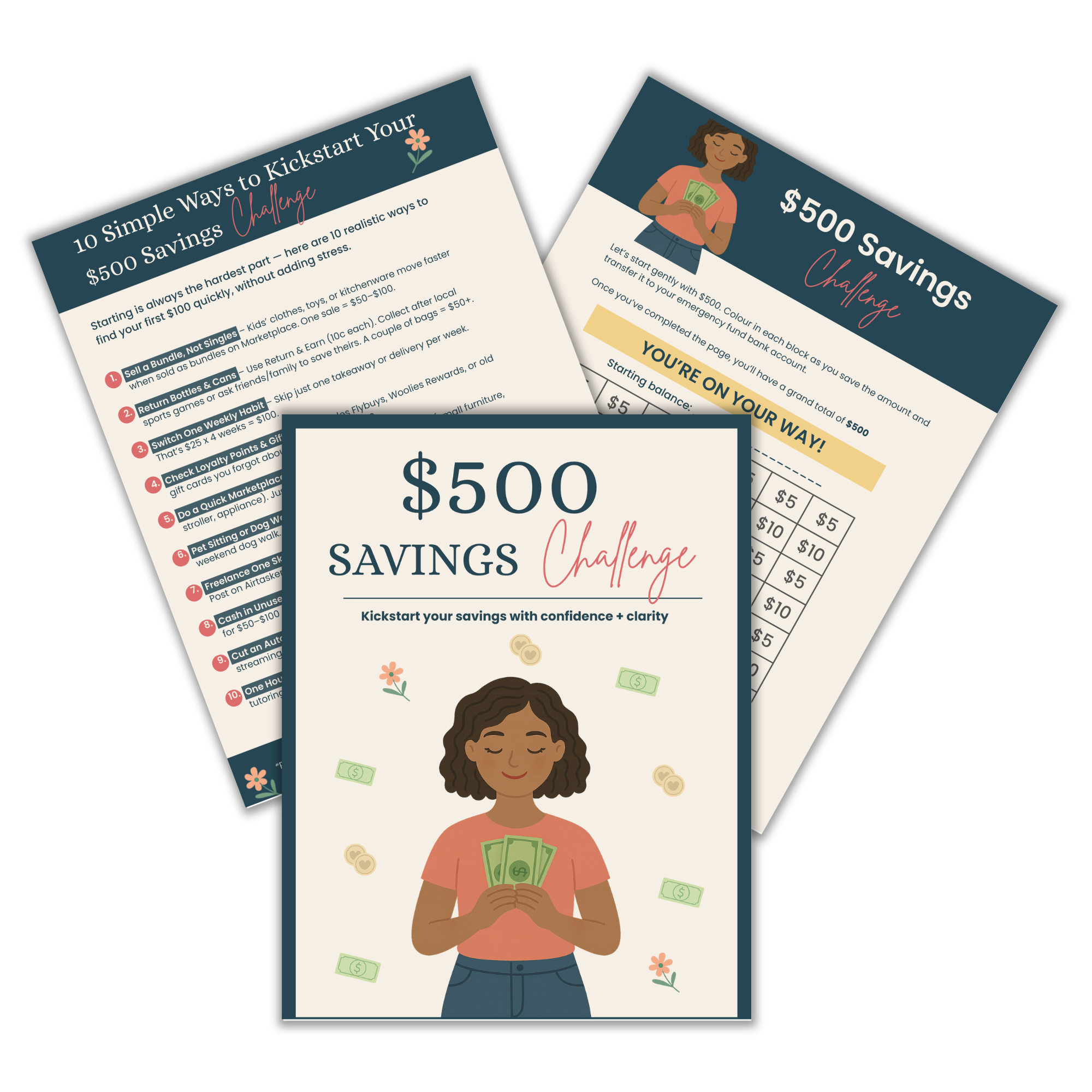
Ready to save your first $500?
Grab the free $500 Savings Challenge and start stacking small, doable savings wins — without cutting out everything you love.
- Visual tracker to see your progress build
- Easy, realistic mini savings ideas
- A simple system that actually feels achievable
🚧 Overcoming Common Pitfalls in Financial Organisation
🥴 Analysis Paralysis and Account Overload
You don’t need 12 colour-coded sub-accounts and six budgeting spreadsheets. Too much complexity can lead to burnout—and eventually abandonment of the whole system.
If you’re hesitating because you’re unsure which categories matter most—start small. Choose three core areas: bills, spending money, savings—and build from there only if needed later on.
Simplicity wins when it comes to sustainability. As long as each dollar has clarity and purpose—you’ve already won half the battle!
📊 Keeping Track Without Getting Overwhelmed
The idea of juggling multiple accounts might sound exhausting—but modern banking tools make tracking easier than ever before.
- Platforms like Up Bank auto-categorise spending and show progress bars toward savings goals.
- Group accounts under one bank/app interface so everything is visible at once without switching screens constantly.
- Make financial review a ritual—not a reaction during crisis mode!
🎯 Action Step: Block out one evening this month for a “Finance Date” with yourself (or partner). Light candles 🕯️ if needed—just review balances across all accounts and realign goals if necessary!
📈 Beyond Organisation: Growing Your Wealth with Strategy
% Maximising Interest Through Account Diversification
Your money shouldn’t just sit—it should grow! Different types of accounts offer different interest rates and benefits depending on their function and provider policies.
- Savings Maximiser Accounts (like ING): Often offer bonus interest when conditions are met (e.g., deposit $1000/month + no withdrawals).
- No branch overheads = better rates passed onto savers!
- If you have a mortgage—keeping cash here reduces interest repayments over time while maintaining liquidity!
[] Risk Management Across Multiple Accounts
Diversifying across accounts isn’t just practical—it’s protective too. Spreading funds means if an institution suffers outages or issues (it happens!), not all your funds are frozen simultaneously.
- The Australian Government guarantees up to $250K per person per institution under the Financial Claims Scheme (source here)—consider spreading across institutions if needed!
- Your Emergency Fund should ideally NOT be card-accessible—to avoid accidental taps during brunch runs!
🎯 Action Step: Review each existing account today: Is it maximising growth AND protected by the FCS? If not—it might be time for a switch!
:
💬 Final Thought: Let Your Bank Accounts Do the Heavy Lifting
You don’t need a perfect system overnight—but taking one intentional step today could completely change how confident you feel financially next month…or even next week!
This week’s mantras:
- Separate bank accounts aren’t extra admin—they’re clarity machines 💡
- Mental accounting turns chaos into calm 😌
- Automation = less stress + more freedom ⏳🔥
So you don’t need a complicated spreadsheet or 12 accounts with colour-coded dashboards to feel on top of your money.
-
Start small—with 3 to 5 purpose-driven accounts
-
Let automation take the mental load off
-
Use account names that speak to your goals (not your bank’s default)
Whether you’re building a “Peace of Mind” fund, organising your bills so they don’t mess with your brunch budget, or finally separating savings for that Bali trip—this system is about making your money feel lighter, calmer, and more in control.
💡 “Structure isn’t restriction—it’s support.”
💬 What account are you setting up first? Tell us below—we’d love to cheer you on! And if you’ve got a clever account nickname, don’t be shy… we’re all about the money hacks around here 💖💸
Want to Take the Next Step With Your Money?
Download the free $500 Savings Challenge and start saving with tiny, realistic wins you can feel proud of.
